You fund it, you use it.
The standard owner-occupier case: the system offsets the building’s own bill. Nothing is charged to anyone. Best fit is a long hold on a site you occupy, where the daytime load is yours.
- Who owns
- You
- Who benefits
- You
Reviewed 13 November 2026 · Tenanted commercial buildings, 100 kW and up
On an owner-occupied site, solar is a smaller power bill. On a tenanted building it is a different asset: the tenant pays for the power, you own the roof, and the system can be structured so the roof pays you. This is how that structure works, what the income is worth, and where it goes wrong.
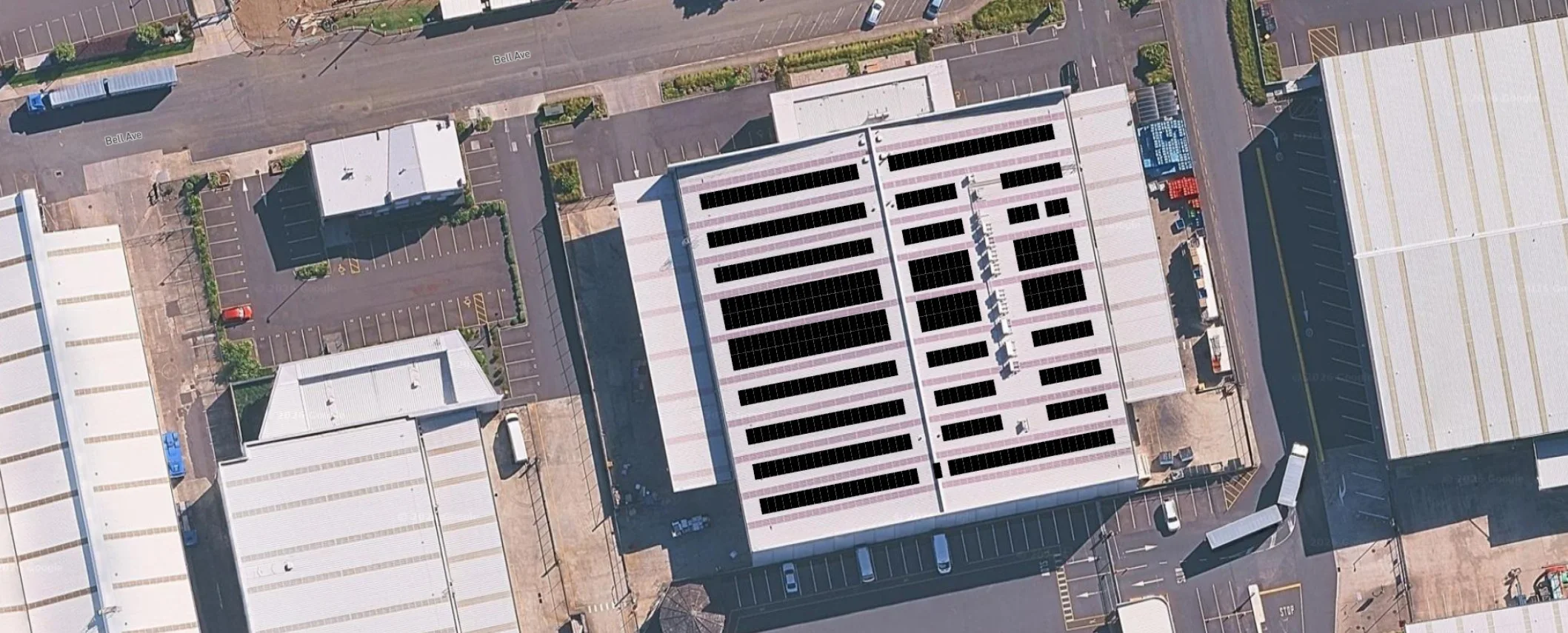
The 272 kW array laid out across a leased warehouse roof, from the design prepared for the property owner
The setup
Most commercial solar is sold as a bill reduction, and on an owner-occupied site that is exactly what it is. On a tenanted building the bill belongs to someone else, and that changes what you are buying.
The owner usually cannot touch the tenant’s electricity contract. The tenant has no reason to put capital into a roof it does not own, and it may not be there in five years. So the building keeps its flat, sunlit, unglamorous roof, and everyone keeps paying the grid for power that the roof could have made.
That gap is the opportunity. The owner funds the system and keeps it. The tenant pays for the solar it consumes at a price below what the grid would have charged, so its costs fall without spending anything. The owner turns a roof that only costs money into one that earns some. Done properly, nobody has to reopen the rent.
Three things decide whether a particular building works: when the load runs, how much life the roof has, and how long the tenant intends to stay.
The options
Who funds the system decides who owns it, who carries the risk, and what the tenant pays. There are only three answers, and only one of them is the subject of this page.
The standard owner-occupier case: the system offsets the building’s own bill. Nothing is charged to anyone. Best fit is a long hold on a site you occupy, where the daytime load is yours.
The landlord structure. You own the system; the tenant pays for the solar the building consumes, at a discount to its grid rate. You keep the export income. Best fit is a tenanted building with a tenant that has time to run.
A power purchase agreement. A provider funds, owns and operates; you or the tenant buy the output for the length of the contract. No capital. Best fit is capital-constrained, or a tenant-led decision.
| Structure | Who owns the system | What the tenant pays | Your capital | On sale |
|---|---|---|---|---|
| Own | You | Nothing new; you take the saving | Full | Asset transfers with the freehold |
| Share | You | Below grid, for solar consumed | Full | Asset and agreement transfer |
| Fund (PPA) | Third party | Contracted rate, all generation | None | Contract transfers, or must be bought out |
The argument
The case for a PPA is capital, and it is a real one. The case against it is what you sign, and it lasts fifteen to twenty-five years.
A provider funds and owns the system; you or the tenant buy the output at an agreed rate for the length of the contract; nothing comes out of your balance sheet. For a capital-constrained owner, or a building where the tenant is the one driving the decision, that is a genuine answer and we quote it. But a PPA is a long commitment to buy, not a free roof.
The provider owns the asset; you do not. The rate escalates, typically around 2% a year, for the life of the agreement. If you sell the building the contract has to travel with it, and a buyer prices that in. If the tenant leaves, the obligation usually stays with the building, and you are paying for power nobody is using.
An owner-funded system with a contracted charge reverses each of those. You own the asset from day one, so it depreciates in your hands and it transfers with the freehold as an asset rather than as an encumbrance. The tenant pays for the solar it consumes, at a rate set below its grid price, and you keep the export income. If the tenancy ends, you re-let the building with the system already on it, or take the export while it is empty. Future Energy calls this a private energy agreement, to separate it from a PPA.
Where a lease already allows the landlord to recover outgoings or supply additional services, the charge can usually be set without reopening the rent or varying the lease. Where it does not, the lease has to be varied, and that is a conversation to have before the design is finalised rather than after.
The mechanics need care. Set per kilowatt-hour, the charge starts to look like selling electricity, and that is where the legal questions begin: whether the arrangement needs authorisation, how it is metered, and how it is settled. Many owners prefer a fixed service charge recovered through the outgoings for exactly that reason. Either way it needs a lawyer, an agreed way to measure the solar, and an agreed way to settle the money — a drafting exercise, not a reason to avoid the structure.
The trade you are making is honest. You carry the capital, the tenant’s credit and the maintenance. In return you own an asset that earns and a building that is cheaper to occupy, which is what a future buyer and its valuer are looking at.
The other side of the same sentence: a PPA’s “no upfront capex” does not remove a fifteen-to-twenty-five-year purchase obligation. The cost moves from capital to commitment, and commitments are what a buyer discounts.
The tenant’s side
An owner-funded agreement only gets signed if the tenant is better off. That is the whole test, and it is not a hard one to pass.
The tenant is not asked to fund anything, change retailer, or accept a worse price. It buys the solar the roof produces at a discount to what it would have paid the grid, and it keeps buying the rest of its power exactly as it does today. The discount applies to the solar consumed, not to the whole bill — a point worth making out loud, because a tenant who hears “15% off” and then reads the invoice carefully will not be a tenant for long.
In the proposals we have taken to owners, the offer is expressed as a share of the modelled benefit: 85% to the owner, 15% to the tenant. That split is our proposal, not a market norm, and it is negotiated — no tenant has accepted one yet. In the contract it lands as a per-kilowatt-hour rate below the tenant’s grid price, set so the two reconcile. Whatever form it takes, three things have to be written down: how the solar is measured, how the charge is invoiced, and what happens at the end of the term or the tenancy.
Where the year-one benefit goes
$28,478, split 85/15Year-one benefit
What makes it up
Who receives it
A year-one benefit of $28,478 on the first building: $22,171 of avoided grid cost and $6,307 of export credit at 10 c/kWh. The split applies to the total, so the tenant’s share is what it gets for hosting the array, and the owner’s share is the return on the capital.
owner $24,206.30 + tenant $4,271.70 = $28,478.00 · year one, ex GSTBoth numbers are modelled — from a quotation and from interval data about twelve months old, adjusted for growth — not measured after the fact. Everything below is gross.
Before operating costs, insurance, tax, finance and any vacancy. Subject to tenant agreement on allocation, measurement and settlement; the split is a proposal, not an accepted term.
The longer view
Payback tells you how fast the capital comes back. It does not tell you what the income is worth, because it ignores the term and the time value of the money.
If you are weighing this against another use of capital, or a buyer is looking at the building, discount the receipts. The model is straightforward: the owner’s share in year one, growing 2% a year, over a ten-year base term with a conditional ten-year extension, discounted at a rate you choose, with no terminal value.
At 10% — the middle of the range we usually show — the ten-year income on the 121.55 kW roof is worth $160,374 against $154,043 of capital, and $235,746 over twenty years. One owner we ran this past said he would discount it at 5%, not 10%. That is his cost of capital, and it changes the answer materially.
| Discount rate | 10-year term | 20-year term |
|---|---|---|
| 5% | $203,045 | $354,995 |
| 8% | $175,645 | $274,819 |
| 10% | $160,374 | $235,746 |
| 12% | $147,057 | $204,775 |
Capital against ten years of income at 5%
$49,002 of valueAt 5% the ten-year income alone is worth more than the system costs — about $203,000 against $154,043. That is the argument for the owner-funded structure in one line, and it is also the number most likely to be overstated in a sales conversation.
It is gross: no operating costs, no tax, no vacancy, no finance, no replacement inverter, and the extension years are conditional on the tenant and the lease. It is not a property valuation. A valuer decides what an enforceable income term and a tenant covenant are worth, and that is a different question from what the receipts add up to.
Three roofs
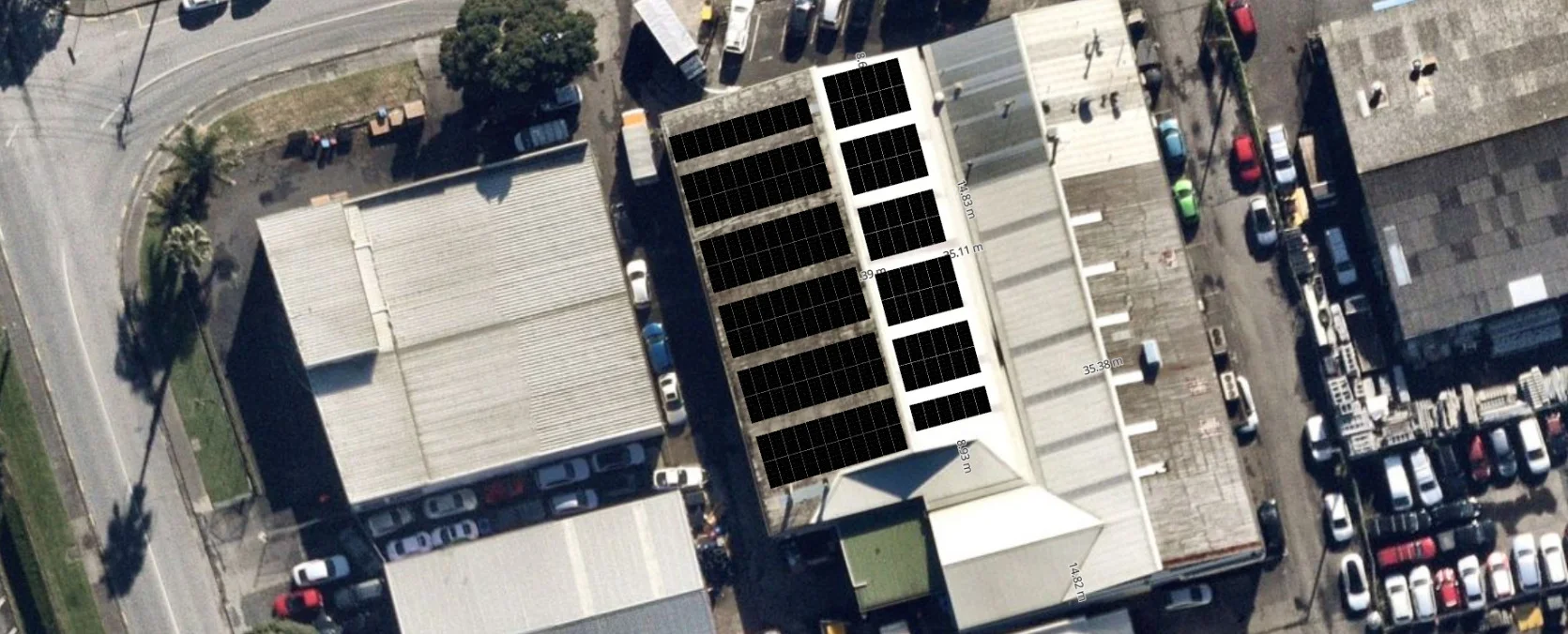
Three properties we have priced, anonymised at the owner’s request. The figures are year-one illustrations from our own quotations, ex GST.
Gross year-one figures before operating costs and tax. Capital recovery is capital divided by the owner’s year-one share, not a discounted return. All three are subject to tenant agreement and a site check.
Worth ruling out
None of the failure modes below are exotic. They are the ordinary reasons a good model underperforms, and they are cheaper to fix before the installation than after.
Quick answers
The next step
The address tells us what the roof can hold. Twelve months of interval data tells us when the tenant uses power, and that decides everything else. With those two things, the split, the capital and the charge are arithmetic.
Sources
Scope: general information about solar on tenanted commercial buildings, for owners and their advisers. It is not financial, tax, legal or valuation advice, and it is not an offer. Case figures come from Future Energy quotations and interval-data models on real buildings, are ex GST, and describe year one only; owners are not named. Discounted figures are gross present values with no terminal value and no deduction for operating costs, tax, finance or vacancy.Free instant check
We develop NSW commercial solar projects and introduce you to one installer we would use for that site. It starts here: type an address and we map the actual building live — about ten seconds, no email, no bill upload.